

When people think about summertime on the TVA, the first thing that comes to mind is world-famous ledge fishing. Ledge fishing seems simple when watching it on TV or YouTube, but it can often be one of the most intimidating techniques for new anglers. The idea of leaving the bank and targeting fish offshore in deep water can feel overwhelming at first, especially on massive fisheries like Tennessee Valley Authority lakes, where bass can roam for miles along river channels and creek ledges.
Unlike shallow fishing, where visible cover like docks, grass, and laydowns helps anglers narrow down productive areas, offshore fishing requires confidence in electronics, mapping, and understanding how bass position themselves underwater. Many anglers spend hours idling, searching for the right school or hard spot before ever making a cast. However, once an angler begins to understand how current, structure, baitfish, and seasonal movements all work together, ledge fishing quickly becomes one of the most exciting and productive ways to catch summertime bass. There are few things in fishing more exhilarating than finding a large offshore school and triggering a feeding frenzy where nearly every cast has the potential to produce a quality fish.
Ledge fishing is a post-spawn period when groups of bass school up on hard spots near creek channels and river ledges. These offshore schools can be tricky to locate and understand, but it can be one of the most fun and rewarding times on the water when everything goes as planned.
Bass tend to key in on areas with a rocky or shell bottom that position well in the current, where they can sit comfortably among other bass and wait for prey to swim by. Anglers will look for places like high spots, points, creek ditches, and shell drop-offs on grass edges to locate ledge bass.
The key forage for offshore bass can vary greatly depending on where they are set up on the lake and how deep they are positioned. A school that is closer to the grass may rely on eating things like bluegill, crawfish, golden shiners, and large gizzard shad. These schools usually are not quite as large as ones found on the main river channel, but they often hold some of the largest bass on the lake.
The deeper ledge schools are extremely current-oriented. Current will often determine their feeding habits and especially dictate how they position themselves on the ledge. These fish have a slightly different diet than the shallower ledge fish, as they are heavily baitfish-oriented. These bass often feed on threadfin shad, crawfish, gizzard shad, skipjack, and even baby catfish and drum. Because these post-spawn offshore bass are not very picky, anglers are able to present them with a wide variety of baits.
Over the years, finding these offshore fish has become easier thanks to technological advancements and high-speed sonar. The most utilized equipment for finding offshore fish today includes side scan, down scan, and mapping. The combination of these three tools allows anglers to sit at the helm of their boat, idle at 3–6 mph, and visually see fish set up along the bottom.
Today’s sonar units are the best they have ever been. Anglers can see in clear detail what the underwater world looks like on each side of their boat using side scan. It is almost as if someone is looking down below without any water there. Along with this, mapping has become so detailed that anglers can key in on small depth changes of just a few inches and identify where hard areas are located without having to guess. Once the boater finds a targeted group of fish, they can use forward-facing sonar, 360 imaging, and mapping to perfectly line up on these schools and make the right bait presentation.
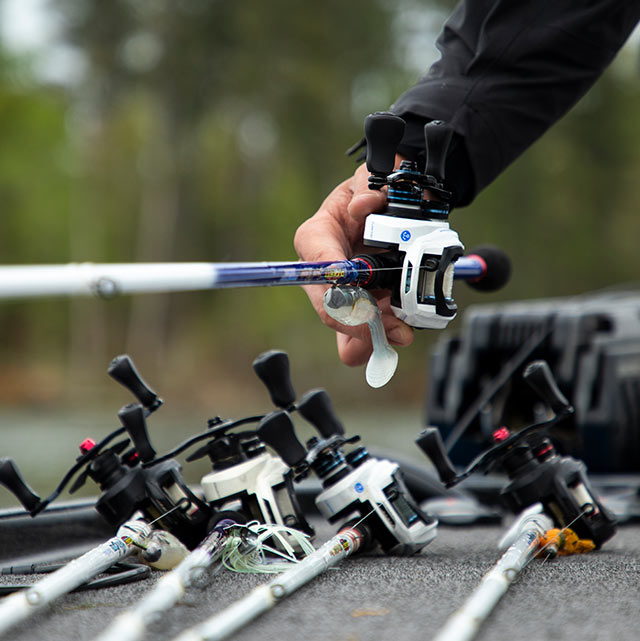
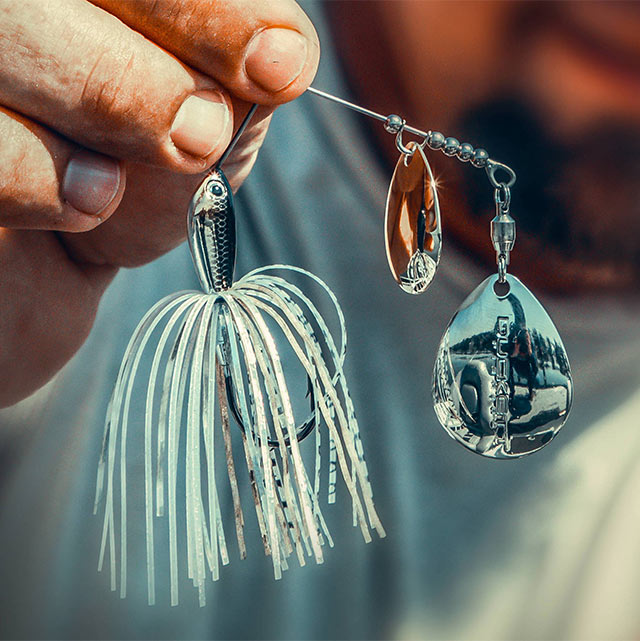
Anglers can present offshore bass with an endless amount of baits. Everyone has their go-to ledge baits. Some of the most common baits used on the TVA include football jigs, magnum crankbaits, flutter spoons, oversized shaky heads, Carolina rigs, Texas rigs, Sway Hair Jigs, BD Hollow Belly Swimbaits, and medium to large glide baits such as the Wall Hanger. These are some of the more aggressive techniques used for larger, more active schools.
There are also many finesse applications that can be deadly effective on offshore schools, such as drop shots, Ned rigs, Neko rigs, finesse jigs, jigging spoons, and more. These can be key players when schools have seen countless baits on a community hole, or on days when there is no current and the bass simply will not eat a larger, more aggressive bait.
Ledge fishing can mean a bass boat deck full of different rods, but when you find that one bait, it can be the difference between catching bass and not catching them. Sometimes all you need to do is get that first bass to fire, and then it’s game over.
There is one specific technique that has seemed to outperform all other techniques on the TVA over the last three years, and that bait, of course, is the jighead minnow combination. With forward-facing sonar technology making such a large impact today, anglers have mastered presenting a minnow-style bait to offshore bass schools.
The jighead minnow application has allowed anglers to present one of the most lifelike baitfish imitations available. This bait can be presented to multiple bass at once, and as the angler shakes their Duckett rod, the bait rolls and floats over their heads, looking like a fleeing or injured baitfish. The top-selling Duckett Fishing rod for this technique is the Jacob Wheeler 2.0 Series 6'10" ML Spinning Rod.
One of the best fish-catching minnows on the market for this technique is the Duckett Fishing Sway Minnow paired with the Sway Jighead. This deadly combo is offered in many of the top minnow colors and three sizes. The jighead itself is what makes the magic happen. The Sway Jighead is designed with an offset weighted head, which allows the bait to roll and shake side to side at 180 degrees as it moves through the water column. This rolling action is what everyone tries to achieve to get the most action and drawing power from the lure.
This bait will often draw the biggest and most aggressive fish out of a school and start a feeding frenzy. Once the bass get smart to the minnow, anglers will often then try the Sway Hair Jig. The Sway Hair Jig presents bass with a more subtle shad presentation while still having the key head roll within the bait. This hair jig is hand-tied with Icelandic sheep wool for maximum movement and durability. It gives bass a unique look at something they do not see quite as often and will usually put a few extra fish in the boat. A lot of times, especially on the TVA, having something a little different makes all the difference in the world.
Whether an angler prefers power fishing with big moving baits or slowing down with finesse techniques, ledge fishing offers some of the best opportunities of the year to catch quality bass on the TVA. With advancements in electronics and an endless variety of effective offshore presentations, anglers now have more tools than ever to target these summertime schools. When everything lines up with current, bait, and positioning, offshore fishing can produce unforgettable days on the water and some of the biggest bass of the season.